
Bench Warrants in Collin County
“Bench warrant” is common public language for a judge’s process after a missed setting or other court noncompliance. In Collin County city courts, the published term may instead be arrest warrant, alias warrant, or capias pro fine. The source court’s wording matters because each label points to a different event and remedy.
Local examples include Frisco’s no-appearance or missed-hearing process, McKinney’s unresolved Class C citation, and a JP ticket where a person failed to complete a granted safety course or deferred disposition. Do not assume every unpaid balance creates the same type of warrant.
Collin County Bench Warrant Labels Vary
Two city examples show why the local term should be copied from the official notice rather than generalized. McKinney calls failure to handle an original Class C citation or appear an “alias warrant.” It uses “capias pro fine” for failure to comply after a guilty judgment. Frisco distinguishes an arrest-warrant route after no appearance from a capias after final judgment.
- Alias warrant
- McKinney’s label for an unresolved original citation or missed appearance.
- Capias pro fine
- Process tied to an unsatisfied final judgment or fine.
- FTA
- Failure to appear; it may be a court status or separate charge depending on the case.
- Recall
- A court action that withdraws process in its record system.
The same phrase may be used differently by another court, so use the exact issuing court and cause number when asking for status.
How a Bench Warrant Is Issued
A missed court obligation can prompt the judge to issue process under the rules that govern that case. The court records the warrant or capias in its own docket, and the sheriff, constable, city officer, or another peace officer may receive it for service. The issuing court—not the serving office—decides recall or the next hearing.
Because Texas has no unified public warrant index, start with the particular clerk whose court handled the missed appearance. A city or JP warrant may not appear in the county sheriff’s public view. The local court page and the notice are stronger clues to the court level than a broad county search.
Collin County JP Bench Warrants Follow the Citation
A JP traffic citation identifies the assigned precinct, court address, phone, citation number, and response date. Use that JP instead of choosing the closest office. The county says a new ticket may take three to five business days to enter case search; a missing new case may simply need a clerk lookup after processing.
JP courts handle traffic and other Class C matters, along with magisterial duties. If a safety-course or deferred-disposition agreement was granted, keep proof of completion and ask the JP whether the court received it. The court’s page warns that failing to finish an approved route can lead to further action.
The citation-processing page illustrates where to find the assigned court and date.
Read the Collin JP traffic-ticket instructions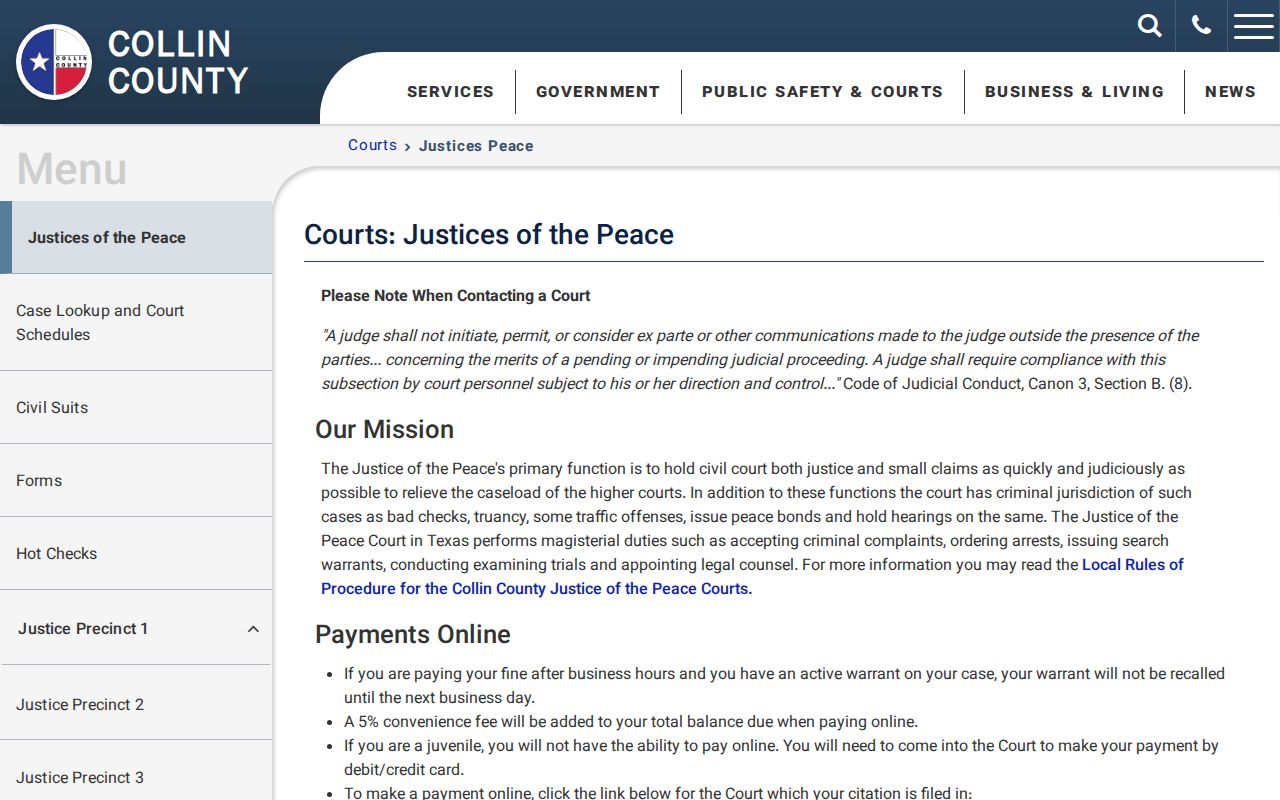
A ticket routes the question to the right precinct, while the judge confirms the current case status.
Bench Warrant vs Arrest Warrant
Both can authorize an officer to bring a person before a court, but the starting point differs. A bench or FTA process grows from an existing court duty. An arrest warrant generally follows a sworn complaint or other charging process supported by probable cause. The court level and underlying record determine where to ask questions.
| Feature | Bench Warrant | Arrest Warrant |
|---|---|---|
| Trigger | Missed date or court obligation | Probable cause tied to a charge |
| Who issues | Judge in the existing case | Judge or magistrate on the required process |
| Underlying record | Pending citation or court case | Complaint, affidavit, or other charging record |
| Resolution | Appearance, compliance, or court recall | Court and bond steps for that charge |
Collin County Capias Pro Fine Follows Judgment
Texas Code of Criminal Procedure Article 45A.259 addresses the municipal and JP capias-pro-fine process. Locally, Frisco and McKinney distinguish that post-judgment path from an arrest or alias warrant after a missed appearance. The distinction is practical: full payment may close an eligible final-judgment capias, while a person who never appeared may need a plea, bond, or judge’s setting.
Ask the clerk whether the balance is final, whether an FTA charge is separate, and whether the court offers a plan or ability-to-pay review. A payment portal alone does not tell you whether the warrant has been recalled.
How to Resolve a Collin County Bench Warrant
Use the issuing court’s instructions. Collin County has no universal walk-in or motion-to-recall process for every JP, city, county-at-law, and district case. A court may offer a voluntary appearance, bond, payment, show-cause hearing, or ability-to-pay review. Confirm what action changes the warrant before taking a payment step.
- Find the citation, case number, city or JP, and missed setting.
- Call the clerk to confirm the label, amount, and whether an appearance or bond is required.
- Ask whether safe-harbor, show-cause, payment-plan, or ability-to-pay options apply to this case.
- Keep the court’s order or receipt and confirm when the public status updates.
Caution: Do not assume a warrant has expired or that an online payment recalled it; verify the required step with the issuing judge’s clerk.
Collin County Warrant Service by Precinct
Four constable precincts divide much of the service geography: P1 includes McKinney and Princeton; P2 includes Wylie and Farmersville; P3 covers Plano east of Coit, Allen, Parker, and Murphy; P4 includes North Dallas, west Plano, Frisco, Celina, and Prosper. This map can help locate a process office, though the citation and issuing judge remain controlling.
Constables serve and return JP and criminal process. Precinct 3 publishes a warrant division line at (972) 881-3069 for clearing and (972) 881-3070 for a county-system check. The image below shows the county’s service area information.
Check the Collin County Constable service map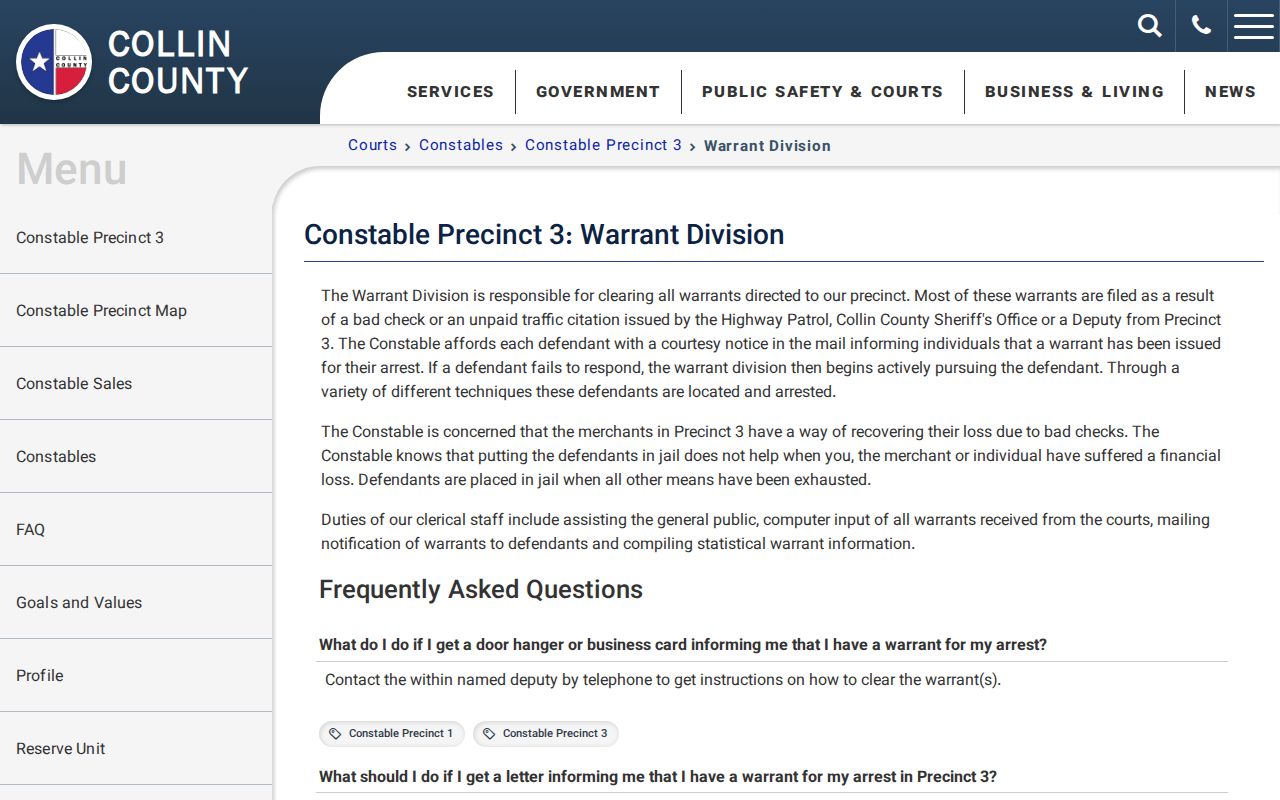
A constable can answer an operational question about process directed to that precinct, but cannot replace the court’s recall order.
Which Collin County Court Issued It
District Court felony process routes to the District Clerk at 2100 Bloomdale Road in McKinney. Class A and B misdemeanor files go through the County Clerk’s County Court at Law criminal clerks. JP traffic matters follow the precinct printed on the ticket; city ordinance and fine-only Class C matters stay with the city’s municipal court.
The sheriff may confirm receipt, service, booking, or bond information, but only the court can set the case remedy. If the case number is missing, use the notice, citation, or court date to help the clerk locate it. The county JP directory lists precinct contacts and locations.
Collin County Warrant Confirmation After Payment
A receipt proves that a transaction was accepted; it does not by itself show the judge recalled a warrant. The clocks differ by system. A JP page warns that after-hours payment may not recall an active warrant until the next business day. Wylie gives up to 72 hours for a city portal update, while DPS estimates up to seven business days after a court reports a license-hold resolution.
Call the issuing clerk with the receipt number and ask whether the court recorded the warrant as recalled, satisfied, served, or still pending. Ask separately whether a state FTA/FTP hold was reported for release.
The county’s four-precinct directory illustrates how service contacts vary across Collin County.
Open the county constable directory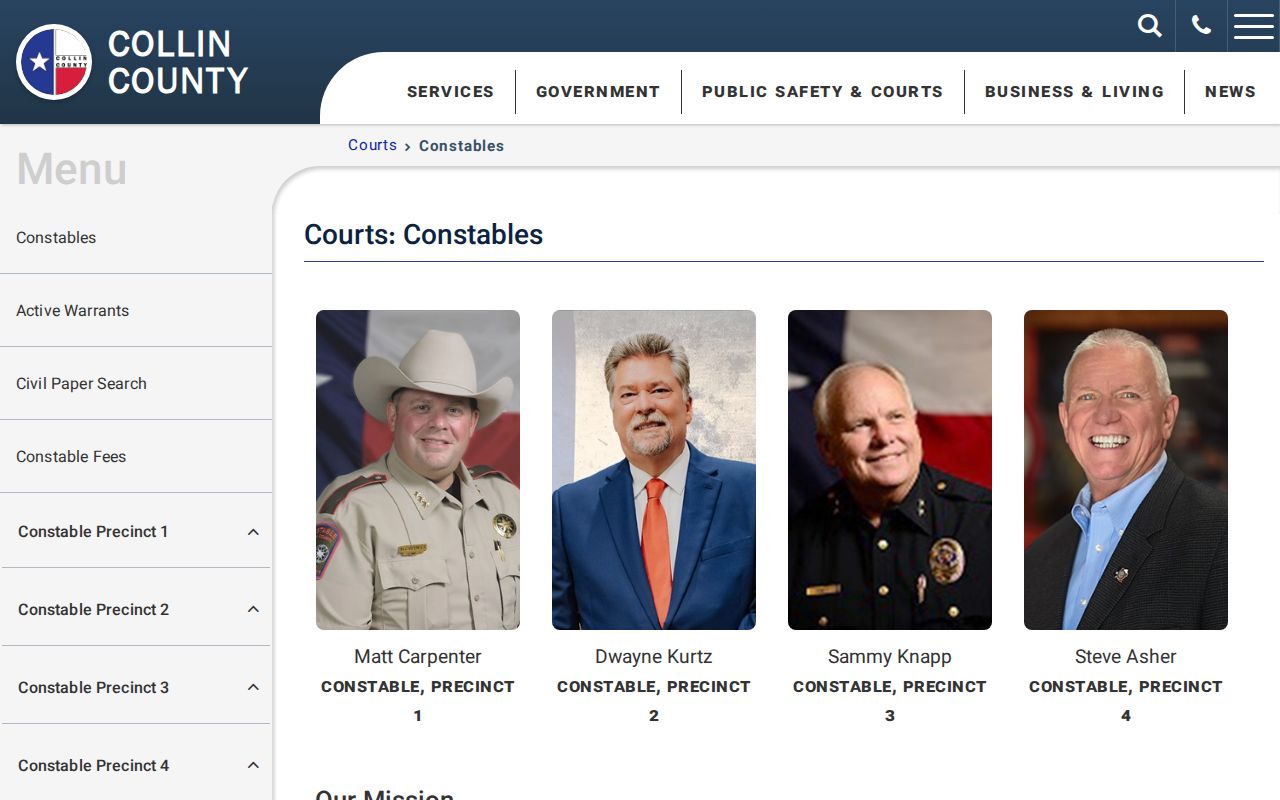
Match the right office and keep written proof of the court’s updated instruction.